
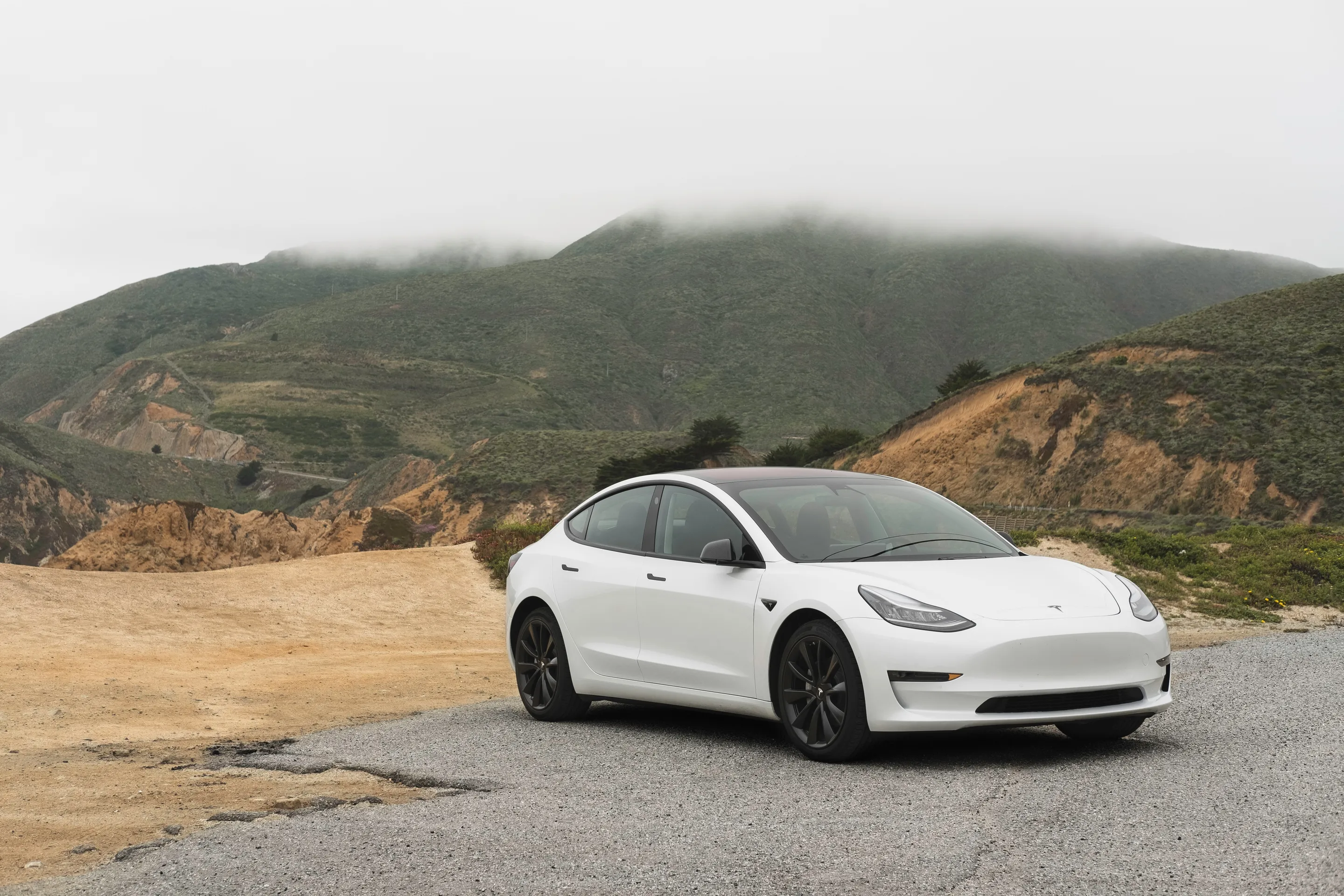
TL;DR – The 30-Second Summary
The problem: Tesla Dog Mode keeps your car cool but doesn’t prevent your dog from opening the door. Dogs can accidentally press the interior door button and escape–especially large breeds like German Shepherds.
The solution: Use rear child locks + keep dog in back seat + add a barrier or crate. Never rely on app monitoring in areas with poor cell signal.
Key takeaway: Dog Mode controls temperature. It does not control containment.
—
A Quick Disclaimer
This article is not anti-Tesla. Dog Mode is genuinely useful for short errands and reduces heat-risk scenarios.
This is about a specific, under-discussed risk: Dog Mode can create a false sense of “containment.” Many owners assume “Dog Mode on” equals “dog safely locked inside.” In practice, the dog may still be able to open a door from the inside–especially at remote trailheads where your phone has no signal to alert you.
The Story That Burned This Into My Memory
I learned this the hard way.
I was hiking. My German Shepherd was in my Tesla with Dog Mode enabled. Temperature set correctly. The big on-screen Dog Mode message displayed. From a human perspective, it felt like the perfect setup: climate controlled, dog comfortable, and (in theory) I could monitor the cabin.
Then the unthinkable happened: my dog pressed the interior driver-door open button and got out.
Tesla’s interior door release is a button/switch that opens the door with a relatively light action (for humans, it feels intuitive; for a dog paw or shoulder, it can be surprisingly easy to trigger depending on angle and pressure). Dogs explore with paws and body weight. They shift positions. They lean. They brace. They get curious. And a working breed like a German Shepherd can be both physically capable and problem-solving driven.
In my case, the result was a near-disaster. The dog ran. The environment was not controlled. The scenario could have turned into a nightmare–traffic, cliffs, wildlife, people, other dogs, loss, injury. The emotional shock is hard to convey: you go from “my dog is safe” to “I may never see my dog again” in seconds.
That moment is why I’m writing this.

Dog Mode Solves Temperature–Not Containment
Dog Mode keeps the cabin at a safe temperature while you step away. The Tesla app can notify you if climate turns off or temperature changes significantly.
That’s real utility. But here’s the mental trap:
Temperature control and physical containment are separate problems.
Dog Mode addresses the first extremely well. Many owners subconsciously assume it addresses the second, too. In many real-world setups, it doesn’t.
The Hidden Assumption Owners Make
- “The car is locked.”
- “Dog Mode is on.”
- “Therefore my dog is locked inside.”
What is often overlooked: being “locked” from the outside does not necessarily mean the door cannot be opened from the inside. In fact, Tesla provides interior mechanisms designed for occupants to open doors even in unusual circumstances, including manual releases intended for emergencies.
This is not a flaw in isolation; it is a design and safety choice. The issue is the mismatch between how owners think Dog Mode works and what it actually guarantees.
Why This Risk Is Worst Where You Use Dog Mode Most
Most people don’t use Dog Mode for quick coffee runs downtown. They use it for activities where dogs can’t go:
- Ski resorts and gondola access
- Trailheads and national park hikes
- Certain beaches, museums, visitor centers
- Remote viewpoints and backcountry pull-offs
In those environments, two things are often true:
1. Cell signal is weak or nonexistent
2. The consequences of escape are much more severe (wildlife, cliffs, distance, exposure, traffic, unfamiliar terrain, limited people)
“But I Can Monitor in the App”–Not Without Connectivity
App monitoring depends on a chain of connectivity:
- Your phone has data service
- Tesla’s servers can relay messages
- The vehicle has cellular signal
At a trailhead with poor reception? Your “real-time monitoring” becomes a dashboard that simply fails to update.
Bottom line: The feature can be doing exactly what it promises, and you still won’t know what’s happening. Dog Mode can make you feel safer than you are, precisely when you’re farthest from control.
Other Owners Report the Same Problem
After my incident, I searched for whether this was a known issue. I found:
- Posts titled “Dog Mode has a big problem!” describing dogs opening the driver door from inside
- Threads questioning whether Dog Mode actually locks the doors
- Discussions noting that window switches may be disabled but door buttons remain active
The pattern is consistent: dogs move, dogs step, dogs press. Owner reports exist, and they match real-world cabin behavior.
Why Tesla’s Door Button Design Matters
Unlike traditional vehicles with recessed pull-handles, Tesla uses an electronic door release button that’s easy to press.
Key point: A paw, leg, or shoulder can activate a button more easily than it can pull a traditional handle.
Dogs don’t need to “understand” the button. They only need to:
- shift their weight against it,
- step on it,
- lean near it while looking out the window,
- scramble (for example, reacting to a sound outside),
- or simply be large enough that normal repositioning results in contact.
A German Shepherd, Malinois, Border Collie, or any large athletic breed has the physical capability to generate enough targeted pressure accidentally.
Why Tesla Doesn’t Disable Door Buttons in Dog Mode
The likely reason: safety regulations require vehicles to allow occupants to exit. Disabling egress controls could create legal issues–especially if a human is inside or a first responder needs access.
But Dog Mode is unique: its entire purpose is to keep a non-human occupant contained while the human is away. That requires different safety considerations.
Tesla could address this without fully disabling exits. Possible solutions:
- Require a long-press (e.g., 2–3 seconds) to open doors while Dog Mode is active
- Require a two-step press (press-and-hold + second confirmation zone)
- Allow owners to enable a Dog Mode “containment lock” for specific doors, with clear warnings
- Integrate a prominent warning in Dog Mode setup: “Interior door buttons remain active; pets may open doors.”
Even if Tesla believes it cannot change behavior for the front doors, it can at least warn users with clarity.
The Chain Reaction When a Dog Escapes
The moment a dog exits unattended, you trigger a cascade:
1. Car alarm may sound: The door opening can trigger the alarm, producing loud sounds that startle and panic the dog–causing it to bolt even faster and farther
2. Immediate hazard: traffic, wildlife, cliffs, ice, water
3. Lost dog risk: unfamiliar environment + high arousal + alarm-induced panic
4. Secondary incidents: dog approaches strangers, dogs, food, property
5. Legal exposure: leash laws, liability, local enforcement
6. Operational nightmare: search efforts, emergency calls, time loss
7. Worst-case outcomes: injury, death, permanent loss, or harm to others
Many owners think of Dog Mode risk as “temperature only.” This door issue changes the risk model entirely.
Tesla Settings That Help (But Don’t Fully Solve It)
1) Child Locks for Rear Doors: Helpful, But Only for the Rear Doors
Tesla’s manual describes child locks for rear doors to prevent them from being opened using the interior release buttons. This is helpful if:
- the dog stays in the rear seat, and
- the dog cannot reach the front door buttons.
However, child locks do not solve:
- dogs that climb into the front,
- dogs placed in the front seat area,
- dogs in cargo areas that can reach front buttons (depending on configuration).
2) Window Lock: Partial Reduction of “Window Accidents”
Tesla documents a rear window lock function to prevent passengers from using rear window switches. But window locking is not the same as door locking. It doesn’t address the core risk: door egress.
3) “Driver Door Unlock Mode” Is Not a Containment Feature
Tesla’s “Driver Door Unlock Mode” affects what happens when you unlock from the outside. It does not prevent a dog from opening a door from inside.
Why App Alerts Are a “Placebo” in the Backcountry
In remote hiking/ski scenarios:
- Your phone may have no service
- Your vehicle may have weak signal
- Notifications may be delayed or never delivered
What you believe: “I’m monitoring Dog Mode.”
The reality: “I have no real-time visibility, and my dog could be out.”
This is why the door risk is so dangerous–it exploits the assumption that “the system is watching.”
Risk Assessment: Which Dogs and Which Setups Are Most Vulnerable?
Higher-risk dogs
- Large athletic breeds (German Shepherd, Malinois, Husky, working mixes)
- High-drive or high-anxiety dogs that pace or reposition often
- Dogs that put paws on armrests or doors to look out
- Dogs that have learned “buttons cause things”
Higher-risk setups
- Dog in the front seats (obvious risk)
- Dog unrestrained in a cabin where it can roam forward
- Dog with access to driver-side door panel
- Remote destinations with poor cell coverage
- Locations where the dog cannot safely be loose even for 30 seconds
Lower-risk (not zero-risk) setups
- Dog restrained in rear seat with child locks enabled
- Dog in a secured crate that prevents reaching door controls
- Physical barrier preventing forward access

6 Workarounds (None Are Perfect)
Let me be direct: none of the current workarounds are perfect. They’re all trade-offs.
Option 1: Put a Cover Over the Door Button
You suggested a cap/cover over the door-open button. Conceptually simple.
Why it’s not ideal:
- In a true emergency (fire, crash, power loss confusion), you don’t want a barrier that prevents rapid exit or confuses a rescuer.
- A cover may interfere with normal human use or become a brittle “hack” that fails under stress.
Option 2: Tether the Dog Inside the Car
Some owners propose tying the dog to a seat anchor or seat belt point.
Why it’s not ideal:
- Comfort and welfare issues (especially during longer waits).
- A bored dog can chew through straps.
- Entanglement risk is real if the dog twists around.
- In a panic (sirens, strangers near the car), tethering can increase stress.
If tethering is used at all, it should be done with a purpose-built, crash-tested harness system designed for canine restraint–never a random rope.
Option 3: A Barrier Behind the Front Seats
In a normal SUV, a sturdy barrier can keep a dog away from the driver door.
Why it’s hard in many Teslas:
- Tesla’s cabin design, open rooflines, and minimalist anchor points can make universal barriers difficult to mount securely.
- Many off-the-shelf barriers are not designed for Tesla-specific geometry.
- You can end up with a barrier that rattles, shifts, or fails under a dog’s weight.
Still, a barrier is one of the better “practical” approaches if you can find a model-specific solution that mounts safely.
Option 4: Keep the Dog Only in the Rear Seat + Enable Rear Child Locks
This is the best “settings-based” mitigation Tesla already supports: rear child locks prevent rear doors from being opened using interior release buttons.
Why it’s not fully sufficient:
- Some dogs can climb or squeeze into the front area.
- A dog hammock helps, but a determined dog may still find a way.
Option 5: Use a Proper Crate Inside the Vehicle
A secured crate prevents access to door controls and is the closest thing to a true containment solution.
Why it’s not always practical:
- Crate sizing for large breeds can be difficult in certain Tesla cargo areas.
- Many owners don’t want the bulk, weight, or installation complexity.
- Improperly secured crates can become hazards in a crash.
But from a “dog can’t press a door button” standpoint, a crate is one of the few genuinely robust mitigations.
Option 6: The “Mr. Bean” Solution — Put a Padlock on the Driver Door From the Outside
You described the only truly reliable (and admittedly hilarious) hack: lock the driver door externally with a physical padlock, like a slapstick comedy prop.
It’s funny because it feels absurd in 2026 to secure a smart EV like a 1970s beater. But purely as a containment measure, it works because it prevents the door from opening even if the internal latch is triggered.
Why it’s still not ideal:
- It introduces emergency egress problems.
- It looks ridiculous (and may attract attention).
- It may violate local laws or create liability if someone is trapped.
- It’s a workaround, not a designed solution.
But yes: in terms of “does the dog get out,” it is effective.
My 5-Step Safety Protocol for Dog Mode
If you take nothing else from this article, take this checklist.
Step 1: Assume your dog can open a door if it can reach the door panel
Do not assume “locked” equals “contained.” Treat the interior door buttons as accessible controls.
Step 2: Build a containment layer that does not rely on cellular signal
Because the app and alerts depend on connectivity, and Tesla itself frames certain notifications in the context of the mobile app. You need a solution that works even in “zero bars” environments.
Step 3: Choose one of these containment stacks (from best to less-best)
Best (most robust):
- Secured crate in cargo area + climate management + short duration
Very good (practical for many owners):
- Rear seat only + rear child locks enabled
- plus a hammock or barrier that prevents forward movement
- plus test: can the dog physically reach any door-open button?
Better than nothing:
- Rear seat + child locks
- plus door-panel protection that blocks direct paw contact
Step 4: Do a “door button test” before trusting any setup
Put your dog in the exact configuration you plan to use, then:
- observe how it moves,
- where it places paws,
- whether it leans into door panels,
- whether it can reach the driver door area.
Most owners never test this until it happens once.
Step 5: Add redundancy for recovery
If your dog escapes, minutes matter.
- Make sure the dog wears an ID tag.
- Consider a tracker (AirTag-style solutions are imperfect but better than nothing).
- Keep recent photos available.
- Have a plan for local animal control and trailhead contact points.
What Tesla Should Do Next
Tesla normalized “don’t leave your pet in a hot car” awareness. Now they need to close the containment gap.
Four improvements that would materially reduce risk:
1. Prominent Dog Mode warning: “Interior door buttons remain active; pets may open doors. Use rear child locks, restraints, or crate.” (This is the bare minimum.)
2. Dog Mode containment option (opt-in):
- Disable interior electronic door-open buttons, or
- Convert them into long-press actions while Dog Mode is active, or
- Restrict door-opening behavior to a specific door (e.g., rear only) with warnings.
3. Connectivity transparency: If the vehicle has weak cellular connectivity, show a warning: ”Remote monitoring may be unavailable in low-signal areas.”
4. A Tesla-designed pet barrier: A model-specific barrier solution that mounts correctly and safely would sell extremely well and reduce risk.
Tesla’s own manual acknowledges features like rear child locks. The next step is integrating those safeguards into the Dog Mode user journey so owners do not have to learn by trauma.
FAQs
1) “Does Dog Mode lock the doors?”
Dog Mode is primarily a climate feature. Owners report that doors can still be opened from inside under certain conditions, and there are multiple owner discussions focused on this risk. If your dog can reach the interior door-open button, treat escape as possible.
2) “Can I rely on app notifications for safety?”
Tesla describes app notifications related to Dog Mode and temperature changes. But if your phone or the vehicle lacks connectivity (common at trailheads), those notifications may be delayed or not delivered. Use containment measures that do not depend on signal.
3) “Is the rear seat safer?”
Yes–because Tesla supports rear child locks that prevent rear doors from being opened using the interior release buttons. However, you must still prevent the dog from reaching the front door controls.
4) “What’s the single most reliable mitigation?”
A secured crate that physically prevents access to door controls is the closest thing to a true containment solution. Everything else is a compromise.
Conclusion: Dog Mode Is Not a Dog Lock
Tesla Dog Mode is a meaningful step forward in pet safety–especially for temperature management. Tesla also notes mobile-app notifications tied to Dog Mode and cabin temperature behavior. But Dog Mode is not a containment system, and for certain dogs–particularly large, athletic, curious ones–the interior door-open button can represent a real escape path.
My German Shepherd opening the driver door while Dog Mode was on is not a story I ever want another owner to live through. And the most dangerous part is not that it can happen–it’s that owners often don’t even know it can happen, and Tesla does not consistently force that realization at the moment Dog Mode is enabled.
Until Tesla improves the feature set or warning design, owners must treat this as a real risk and add their own containment layer.
Related Articles
- Pet Travel Safety: Manifest Cargo vs Checked-in Baggage – Understanding safety standards for different travel methods
- How Safe Is International Pet Freight Shipping by Air? – Air travel safety for pets
A Note from Transcon Pet Movers
Incidents like this are a reminder of a broader truth: pet safety is rarely about a single feature–it’s about layered risk management. That principle applies even more when you’re relocating internationally, where long transport windows, unfamiliar environments, and stress variables stack up quickly.
If you’re planning an overseas move with your dog (or any pet), Transcon Pet Movers helps clients manage the end-to-end risk profile: compliant routing, airline and crate requirements, document coordination, and practical travel-readiness planning. The goal is the same as in Dog Mode–comfort and safety–but executed with redundancy, realism, and experience.
Planning an international move with your pet? Get a free quote from Transcon Pet Movers and ensure your companion travels safely.
Selected Sources
- Tesla Model 3 Owner’s Manual – Climate Controls (Dog Mode)
- Tesla Model Y Owner’s Manual – Climate Controls (Dog Mode)
- Tesla Model X Owner’s Manual – Climate Controls (Dog Mode)
- Tesla Model 3 Owner’s Manual – Child Locks
- Tesla Model Y Owner’s Manual – Child Locks
- Tesla Model X Owner’s Manual – Child Locks
- Tesla Motors Club: Dogs can open the car in Dog Mode
- Cybertruck Owners Club: PSA: Dog Mode unsecure!! Door opened by dogs
- Torque News: Tesla Cybertruck Owner Says Dog Mode Has a Safety Issue